
FROM VENICE TO THE WORLD: "CONNECTING INTELLIGENS" PANEL DEBUTS AT THE ARSENALE
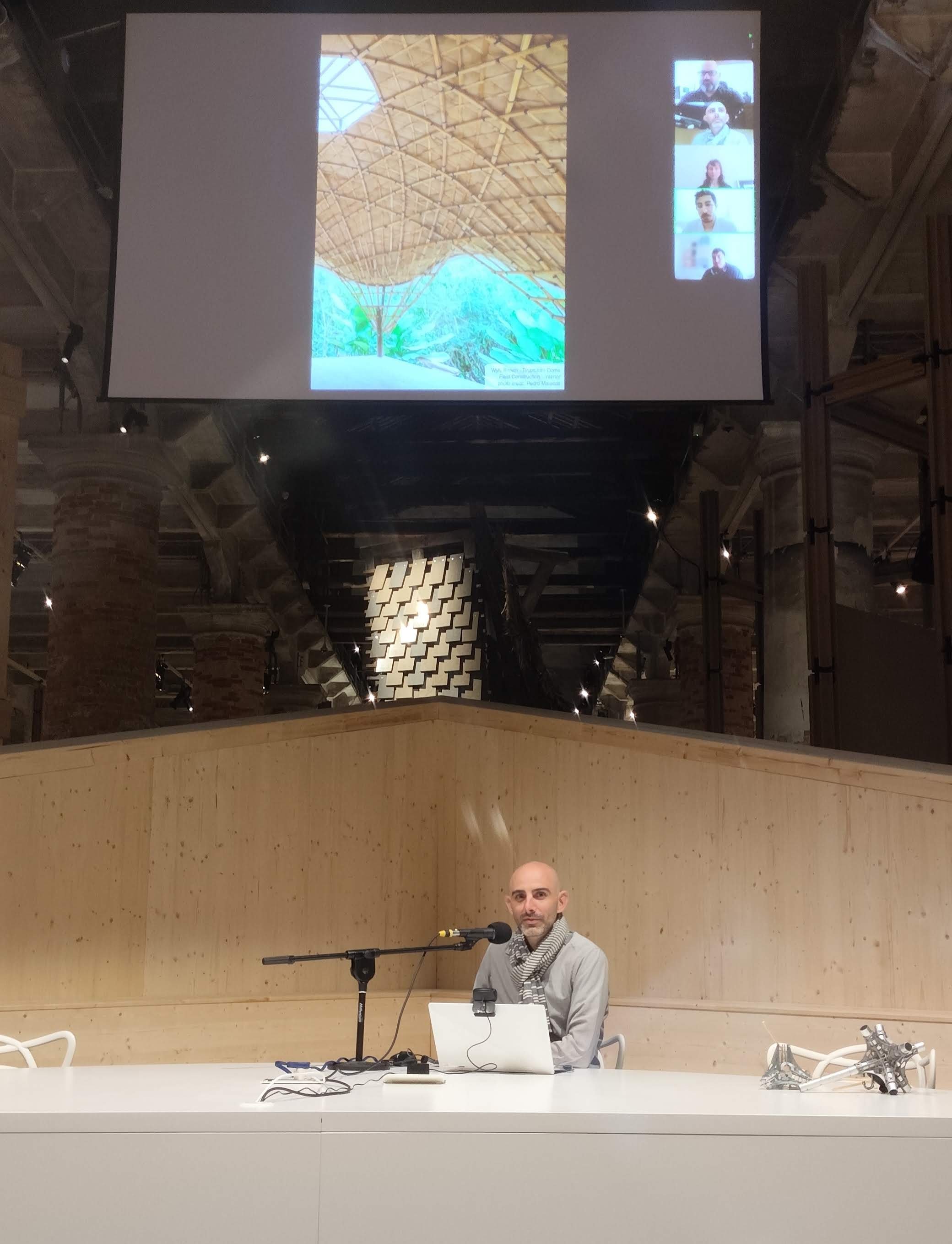
VENICE, ITALY — On May 23, 2025, the historic Arsenale served as the backdrop for a deep dive into the future of structural design. As part of the 19th International Architecture Biennale, curator R. Spencer Steenblik convened a panel of international designers for a session titled "Embedding Intelligens into the Design of Architectural Connections and Joints".
The discussion took place at the GENS Speakers’ Corner, a dynamic public programming space designed for "Natural Artificial Collective" discourse.
A Hybrid Dialogue on Material Wisdom
The panel was a centerpiece of the "Connecting Intelligens" exhibition, which explores how the humble joint—the point where two materials meet—serves as a primary site of architectural innovation.
The conversation was uniquely structured as a hybrid global exchange. While Steenblik moderated from the Arsenale, he was joined via a live video link by a distinguished group of contributors: Virginia Melnyk (@virginiamelnykdesigns), Wyly Brown (@wylybrown), Tyler McMartin (@tylrmcmartin), Alireza Alikaei (@alirezaalikaei), Jonathan H. Nesci (@jonathanh.arch), and Jonathan Hill.
From Molecular to Monumental
Central to the panel’s focus was the work of the Carbon Natural Research Team. Their research investigates how carbon molecular structures can be translated into physical architectural systems. By studying natural, tri-symmetrical molecular "intelligence," the team demonstrated how architects can create sustainable, resilient joints that minimize material waste while maximizing formal flexibility.
Physical prototypes and models were displayed during the session, giving attendees a tactile look at:
Digitally-optimized joints that reduce material footprint.
Tensile systems inspired by organic biological forms.
Innovative interfaces between dissimilar materials.
"The architectural joint is more than a point of connection; it is where structural behavior, aesthetic expression, and environmental performance collide."
Continuing the Journey
The May 23rd panel served as a bridge between the exhibition’s opening in Venice and its subsequent international tour. Following its successful run at the Courtyard of C.S. Gregorio through May, the exhibition traveled to City Meble in Poland for the month of June.
This panel discussion, supported by the Indiana University Presidential Arts and Humanities Fellowship, solidified the exhibition's role in the global conversation regarding how we build more "intelligent," adaptable, and sustainable structures for the future.